
-
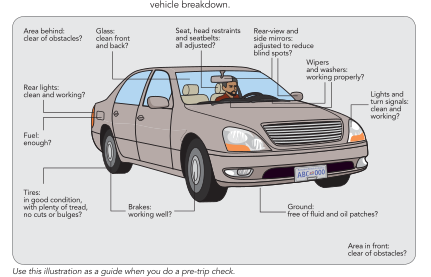
Be at least 25 cm (10 in) away from the driver’s airbag.
-
Position head restraint as close to the back of head as possible.
-
Buckle up seatbelts even on short trips, since most injuries and deaths occur close to home.
-
If there is any doubt about who has the right-of-way, or if there is any chance of a crash, it’s always better to yield the right-of-way to the other person.
Use hazard lights only to warn that the vehicle is stopped unexpectedly or poses a potential hazard to other traffic, not simply because parking or stopping briefly.
When seeing a collision or hazard ahead, warn drivers behind using these methods:
-
Turn on your hazard lights.
-
Lightly tap brake pedal three or four times.
stale green light — a stale green light is one that has been green for a long time, and is about to turn yellow.
-
If you did NOT see the light turn green, then it may be stale. Look for additional clues:
-
are there a lot of cars lined up on the cross street waiting for the light to change?
-
in many areas, the crosswalk signal will change from a white figure to an orange hand just before the light turns yellow, or will show how many seconds are left before the traffic light will change.
-
point of no return —as you approach a stale green light — taking into consideration your speed, the road conditions and the traffic behind you — decide on a point of no return where you will no longer be able to stop safely.
-
When you reach a point of no return, keep on going even if the light changes to yellow.
steady yellow light — yellow means that the signal is about to turn red.
-
You MUST stop before entering the intersection unless you can’t safely stop in time before a steady yellow light.
-
If you are in an intersection waiting to make a left turn and the light turns yellow, remember that you are legally allowed to complete your turn. But watch carefully for other vehicles, especially oncoming drivers trying to beat the red light.
see-think-do
-
see — scan for hazards by paying attention to other road users and the areas where hazards could occur.
-
think — decide which hazards are the most dangerous, think quickly about possible solutions, and decide on the safest one.
-
do — do manoeuvres to keep yourself and others safe.
Strategies: the observation cycle
Always keep your eyes moving while you’re driving:
-
look well ahead
-
scan from one side of the road to the other, checking for potential hazards
-
glance in your rear- and side-view mirrors to keep track of what is happening behind you.
-
start all over again to complete the cycle every 5–8 seconds.
-
Look ahead to make sure you know what’s coming up by scanning at least 12 seconds ahead.
-
Look in side- and rear-view mirrors about every 5–8 seconds and pay attention to what you see.
-
check the rear-view mirror before slowing down or stopping.
-
check the side-view mirrors whenever planning to change road position or direction.
-
-
Whenever planning to change direction or road position, do a shoulder check to make sure the blind spot on that side is clear.
-
Before backing up, do a 360-degree vision check to look all around the vehicle using shoulder checks and mirror checks, then turn your body to look out the rear window while backing up, and occasionally check in other directions.
-
When approaching an intersection, scan the crossing road — look left, centre, right, then glance left again.
-
Try to look at least 20 seconds ahead when driving on highways and freeways. At 90 km/h that’s almost half a kilometre.
-
Increase space to get better visibility.
Be careful NOT to drive in an area of reduced visibility, such as behind or beside a large truck, which can act like a billboard, blocking your vision.
-
Be aware that large vehicles can cause wind turbulence.
-
Make sure you’ve space around your vehicle, and keep at least a three-second space in front of you.
-
Be ready to see-think-do, as things can happen fast on a highway or freeway.
Strategies: making your move
Check mirrors and do a shoulder check whenever planning to:
-
pull out from the side of the road
-
pull over to the side of the road
-
change lanes
-
turn left or turn right.
A hazard is anything in the driving environment that could harm you or other road users, and can be grouped into four main categories: space conflicts, surprises, vision blocks and poor road conditions.
All these solutions involve speed control, steering, space margins and communication.
-
Drive at a safe speed to buy you time to stop if you need to.
-
Speeding is risky, but the safest speed isn’t always the slowest speed.
-
Aim for a speed that’s appropriate for the conditions in which you are driving.
-
The posted speed is the maximum for ideal conditions only.
-
Choose a slower speed if the conditions are not ideal — for instance, if the roads are slippery or visibility is limited.
-
To keep a steady speed, use your brake and accelerator smoothly.
-
-
Keep both hands on the outside of the wheel to maintain good steering control.
-
Steer the vehicle in a smooth line so there is little side-to-side movement when you’re driving.
-
-
Space cushions — sometimes called space margins — are areas of space around your vehicle that help prevent space conflicts and give you time and space to react to if something happens ahead or if a hazard comes toward you from the side or behind.
-
Let other road users know what you are doing so they can react in time. Watch for communication from other road users.
Space in front — the two-second rule
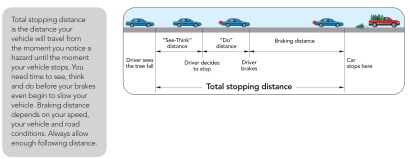
Always leave a safe following distance between your vehicle and the vehicle in front of you.
-
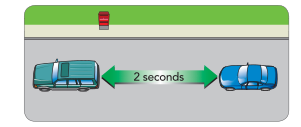
Leave at least two seconds of space in front in good weather and road conditions, and at least four seconds of space in bad weather conditions or on uneven or slippery roads.
-
Leave at least three seconds of space on high-speed roads, when following a large vehicle or motorcycle, when a vehicle is tailgating you, or when following another vehicle on an unpaved road where dust or gravel may be in the air.
Space behind
You can’t control the space behind you in the same way as the space in front. What do you do when someone is tailgating you?
-
It’s a good idea to slow down slightly to increase your space in front. This way, if you have to stop, you can stop more gradually and there will be less chance of a rear-end collision, the person behind crashing into you.
-
Other options are to move into another lane or to pull over to the side and let the tailgater pass.
Space beside
-
When passing a cyclist, pedestrian, or other vulnerable road user, slow down, pass when it is safe to do so and provide plenty of space.
-
Leave at least 1.0 metre of space when passing a cyclist, pedestrian, or other road user, such as those using a personal mobility device.
-
Leave at least 1.5 meters when passing on roads with speed limits above 50 km/h,
-
Leave at least 0.5 metre if a person is on a sidewalk or protected cycle lane.
Lane position
When deciding where to position your vehicle in the lane, there are several things to consider:
-
on a two-lane road, stay fairly close to the centre line so other vehicles do not move into your lane space
-
in the curb lane, stay well away from hazards on the side, such as car doors that might open
-
in most lanes, drive near the centre of the lane
-
avoid driving in other drivers’ blind spots.
-
on a multi-lane road, the right lane is often the safest choice because it keeps you away from oncoming traffic and reduces the chance of being tailgated.
Choosing a safe gap
The space to get across an intersection safely or to merge into a line of traffic is called a gap, and deciding on whether a gap is big enough to be safe isn’t always easy.
-
the speed of the traffic
-
the time it will take to do your manoeuvre
-
the time it will take your vehicle to accelerate to the speed of the traffic flow.
Be careful NOT to underestimate the speed of approaching motorcycles or bicycles, as they are often travelling much faster than they appear to be.
Always use turn signals (i.e., turn lights or hand signals) to let people know you are planning to turn, change lanes, pull out, or pull over.
-
be timely — signal well ahead to give other road users plenty of warning.
-
be clear — don’t apply turn signals too soon and confuse other people.
If you plan to turn right at the next intersection and there are a number of driveways and lanes before you reach the intersection, wait until you are close enough that people can see exactly where you are planning to turn.
-
mean what you say — a turn signal is designed to switch off after you have made a turn, but sometimes it doesn’t. Make sure that your signal has cancelled after you turn so it doesn’t give the wrong message.
Eye contact
You can often communicate with other road users just by using your eyes.
-
When you stop for pedestrians, make eye contact so they know you have seen them and it is safe for them to cross.
-
Do the same for other drivers, motorcycle riders and cyclists when you are stopped at an intersection.
Body language
It is generally NOT a good idea to wave your hand to let another driver proceed, or a pedestrian cross in front of you, as the other driver or pedestrian may face hazards you can’t see.
Vehicle language
You can tell a lot about what a driver is going to do by watching vehicle language.
-
If a vehicle moves over in the lane, the driver may be planning to change lanes or turn.
-
If the vehicle slows down when approaching a corner, the driver may be planning to turn.
-
When you see a parked vehicle with its wheels turned out, the driver may be planning to pull out into traffic.
Two- and three-point turns
-
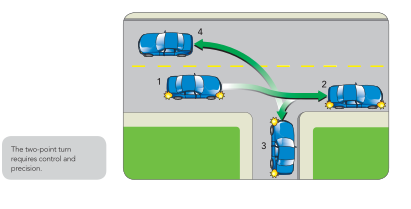
A two-point turn is done by stopping near the side of the road, backing into a driveway and then turning into the street to proceed in the opposite direction.
-
A three-point turn is done by making a sharp turn to the left in the middle of a block, and stopping just before the curb.
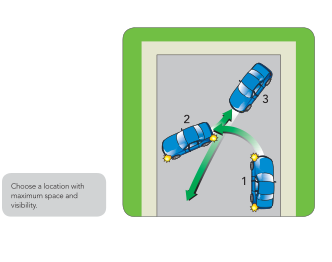
Note: In front of a fire station, never use a fire station driveway to turn around.
You share the roads with a number of different road users, including:
-
pedestrians (for example, children, people in wheelchairs and traffic control people)
-
cyclists
-
motorcyclists
-
If the rider shoulder checks or the motorcycle leans, the rider is probably planning to change lanes or turn.
-
Never try to share a lane with a motorcycle, as a motorcycle needs the whole lane to travel safely.
-
Allow at least three seconds of following distance when you are behind a motorcycle because:
-
Motorcycles can stop very quickly.
-
Motorcyclists can skid and fall because of poor road conditions, and you need to leave plenty of room to stop safely.
-
-
Allow plenty of space when you pass a motorcycle, as your vehicle may throw dirt or water in the rider’s face.
-
Motorcyclists often ride in the left part of the lane to make themselves more visible.
-
-
drivers of:
-
passenger vehicles
-
large vehicles (for example, motorhomes and commercial vehicles)
-
buses (school and public transit)
-
emergency vehicles
-
trains.
-
Any time you approach a crosswalk or intersection:
-
Be aware of vision blocks.
-
Don’t pass if you see a vehicle stopped at a crosswalk — it’s illegal and unsafe. The driver could have stopped to let pedestrians cross the road.
-
-
Don’t enter a crosswalk without checking to see that it’s empty, even when the light is green.
-
Someone may be trying to dash across.
-
People who find it difficult to cross the road quickly, such as the elderly, people with disabilities and parents walking with young children, may still be in the crosswalk.
-
-
Watch out for pedestrians on the cross street whenever you make a turn.
Strategies: being a safe pedestrian
Just as drivers need to carefully observe for pedestrians, pedestrians also need to carefully observe for drivers. You can make yourself safer when you are walking by remembering a few simple rules:
-
Do not leave the curb unless you are sure the approaching vehicles on the cross street have stopped or will stop.
-
Watch for vehicles that are turning.
-
Always hold a child’s hand while crossing the street until they are old enough to understand safety rules.
-
Do not start to cross if the traffic signal is flashing a warning (for example, an orange hand).
-
Use crosswalks.
-
Always activate the pedestrian crossing signal if there is one.
Strategies: being a safe cyclist
If you are a cyclist, you’re responsible for sharing the road in a way that keeps you and others safe.
-
Be predictable. Cyclists are more predictable if they follow the rules of the road.
-
Be visible. Because bicycles are narrow, you need to work at making yourself visible. Wear bright or reflective clothing, especially in the dark or in poor weather. Position yourself so drivers can see you. Avoid riding in blind spots.
-
Ride defensively. Think and look well ahead. Be assertive, but remember that a conflict between a cyclist and a motor vehicle usually results in injury to the cyclist.
-
Ride legally. In B.C., you must wear an approved bicycle helmet. If you ride at night, your bicycle must be equipped with a front white headlight visible at 150 metres, and have a rear red light and a red rear reflector.
Large vehicles
Give large vehicles lots of room, as they operate quite differently than cars.
Allow following distance — a big vehicle can prevent you from seeing hazards ahead.
-
Increase your following distance to have a wider range of vision
-
Leave extra space in front of your vehicle.
-
If you are stopped facing uphill behind a large vehicle, remember that it may roll backwards when the driver releases the brake.
-
In rainy weather, large vehicles can spray dirt or water onto your windshield, reducing your vision.
-
large vehicle tires may also spray up rocks that could hit your vehicle.
-
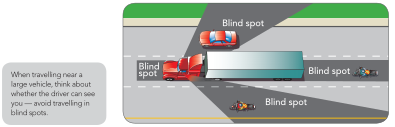
Keep clear of blind spots — there are large blind spots both behind and beside large vehicles.
-
Each vehicle has smaller blind spots at the front and at the back, as well as the two large blind spots on the sides, while their size depends on the shape and size of your vehicle.
-
Make sure you keep out of the blind spots, otherwise the driver will not see you.
-
You should be able to see both mirrors of the truck or bus in front of you.
-
NEVER try to sneak behind a truck if it is backing into a loading bay or out of a driveway — you will enter one of the truck driver’s blind spots and risk being hit.
Allow space when passing — you need a lot of space when passing, and remember that trucks are long — some pull two trailers.
-
Don’t pass unless you are sure you have enough space.
-
If you pass a large vehicle, or make a lane change in front of one, remember to leave extra room before you pull in, as big vehicles take longer to slow down.
-
Make sure you can see the truck’s headlights in your rear-view mirror before you re-enter the lane, and maintain your speed once you get there.
-
If you see a truck starting to slow down well before a red light, remember that the driver requires all of that space to stop in time. NEVER move into that space — you could be rear-ended.
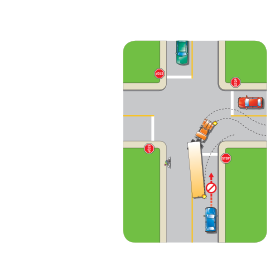
Make room for turns — big vehicles need a lot of room to turn.
-
When they turn right, you may be squeezed between the truck and the curb.
-
You may also have a space problem if you are on a road that a large vehicle is turning onto, because the driver may need to cross the centre line or cut a corner in order to complete a turn. Again, KEEP YOUR DISTANCE.
-
Avoid being on the right of a large vehicle if there’s a chance it might turn right.
Avoid turbulence — big vehicles create turbulence that can push you away from the vehicle or pull you towards it.
-
Turbulence can cause problems when you are passing a big truck, or when you meet one coming toward you.
-
Allow lots of space on the side, and keep a firm grip on the steering wheel.
Signal well ahead — if you are ahead of a large vehicle, signal well before you slow down, turn or stop, because large vehicles need lots of time to slow down.
Highway or freeway entrances and exits
Entrance
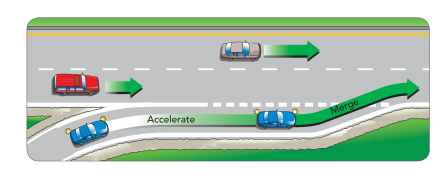
The entrance consists of an entrance ramp, an acceleration lane and a merging area.
Note: Some freeway entrances have ramp meters — a traffic light that controls traffic entering the freeway by restricting the number of vehicles that may proceed along the entrance ramp.
-
While you’re on the entrance ramp, scan the freeway traffic for a safe gap.
-
On the entrance ramp, leave a lot of space between your vehicle and the vehicle ahead.
-
Look well ahead, but check in your mirrors for a safe gap in the freeway traffic.
-
-
The acceleration lane, which is divided from the rest of the roadway by a solid white line, is used to match your speed to the speed of traffic on the freeway.
-
Use the acceleration lane to get up to the speed of the freeway traffic while remaining within the speed limit.
-
Once you’ve done this, the rest of the manoeuvre is really a lane change.
-
-
The merging area, which is divided from the freeway by a broken white line, is used to find a safe gap to merge with freeway traffic. Be aware that cycling is permitted on some freeways, so be careful not to cut in front of a cyclist.
-
Check your mirrors, signal and check your left blind spot.
-
Move into the nearest lane and centre your vehicle.
-
Note: Avoid stopping at the end of the merge lane, as this is an invitation to be rear-ended and leaves you no room to accelerate onto the freeway.
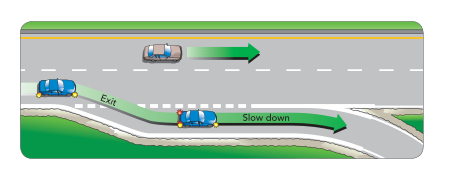
Exit
The exit lane allows you to move off the freeway and reduce your speed.
-
If you’re not already in the right lane, move into it well in advance of the exit, making sure you mirror check, signal and shoulder check.
Most freeway exits are numbered. Before you start your trip, check a map to see which exit you will need to take. That way you can move to the right lane in plenty of time for the exit.
-
Mirror check, signal and shoulder check before turning into the exit lane.
-
Maintain your speed until you’re in the exit lane, then slow down to posted speed.
Note: If you pass your exit, go on to the next one. Never stop and back up.
Strategies: freeway courtesy
When you are driving in the right lane of a freeway, other drivers may try to merge from an entrance lane. It’s not always easy for them to find a safe gap. Use these pointers to help them merge safely:
-
pull over into the left lane (if it’s safe) to give them room to merge onto the freeway
-
adjust your speed to allow a large enough gap for them to move safely into.
Strategies: seeing and hearing effectively
-
Use glasses or contact lenses if you need them.
-
Scan systematically as you drive.
-
Repair or replace a noisy engine muffler.
-
Don’t play your stereo too loudly.
-
Don’t use a cellphone or headphones while driving.
Strategies: what to do if you’re not feeling well
-
Take the bus or get a friend to drive you.
-
Read the label carefully if you are taking any medications. Don’t drive if the label says the drug may cause drowsiness or dizziness.
Strategies: staying awake
-
Start out well rested.
-
Take breaks. Walk around and get some exercise.
-
Stop and eat, but avoid heavy meals because they may make you feel sleepy.
-
Keep the heat level moderate.
-
Keep a window open for fresh air.
-
Sing or talk to keep yourself paying attention.
-
Pull over to a rest stop and take a nap (be sure to lock your doors).
-
Don’t drive too far at one time. If you are making a long trip, be especially careful on the second day. This is when tiredness is most likely to affect you.
Strategies: Leave your phone alone
-
Leave your phone alone while driving, turn it off and put it somewhere it won’t distract you.
-
No call or text is so important it’s worth risking your life.
-
Let calls go to voicemail and ignore your text messages while driving.
-
Pull over and stop your car if you need to use your cellphone or other electronic device.
-
Pull over and look after whatever is distracting you — check the map and figure out the best route, look for the music you want to play, send a text message, etc.
-
Assign a designated texter. Ask your passengers to make or receive calls and texts for you.
-
Make a ‘text stop’ at highway rest areas, some of which now provide free Wi-Fi.
Strategies: controlling emotions
-
Keep learning. Analyze stressful driving situations you have found yourself in, and figure out what you can do next time to be calmer and safer.
-
Plan ahead. Choose a route that avoids crowded traffic so you can concentrate better.
-
Allow yourself plenty of time. Being in a hurry can cause you to become angry or frustrated. Realize that if you leave late, you’ll arrive late.
-
Think of your own safety and the safety of others. This can help you calm yourself.
-
Be patient and extra courteous. Remember that all drivers make mistakes. Take a couple of moments to calm yourself down and leave your problems behind before you start to drive. If you can’t focus, don’t get behind the wheel.
-
Be honest with yourself. Admitting to yourself exactly how you feel can often help to calm you down.
-
Open the windows to let in some fresh air and take a few deep breaths.
-
Listen to the radio or a relaxing CD.
-
Loosen your grip on the steering wheel. This will help to ease your arm and neck muscles and reduce the chance of you getting a headache.
Strategies: protecting yourself from impaired drivers
-
Learn about the effects of drugs and alcohol. Accurate information allows you to make informed decisions.
-
Refuse to ride with drivers who may be impaired. Ask to be let out of the car if necessary.
-
Take a stand — don’t let someone who may be impaired drive.
-
Choose a designated driver before going out.
-
Keep money aside for a bus or taxi.
-
Call a friend.
Strategies: identifying your driving attitude or style
-
Ask someone you trust to give you some feedback on your driving skills, driving attitude and driving style.
-
Analyze your attitude and style. If you have a close call, ask yourself why it happened, and think about how you can drive more safely so it doesn’t happen again.
-
Be critical when you watch a car ad or a car chase scene in a movie. Ask yourself: What message am I getting? Do I agree with this message? Will this message affect my driving attitude or style?
-
Do you find yourself always blaming others for bad driving? If so, then ask yourself: Is it really their fault or could it be me?
Strategies: handling negative peer pressure
-
Identify the problem. You may impress your new friend if you drink, but you aren’t fulfilling your promise of staying sober and being the designated driver.
-
Think about the consequences. If you choose to have a drink so you don’t upset your friend, you increase the risk of being involved in a crash when you get behind the wheel. You could hurt or even kill yourself or someone else.
-
Identify alternatives. Suggest to your friend that you’ll have a drink with them another time when you don’t have to drive.
-
Follow through. Stay sober, and when you are ready to leave, offer your friends a ride.
Strategies: being a good passenger
-
Avoid heated or emotional conversations, as these can distract the driver.
-
Discourage reckless driving.
-
Be prepared to take a stand for safety.
Strategies: keeping passengers safe
-
Refuse to move unless everyone is wearing a seatbelt.
-
Tell children the rules before you start the trip.
-
Give children activities if it’s a long drive.
-
Tell passengers that you will not be able to talk very much because you need to concentrate on driving.
-
Use humour with your friends. For example, tell them you’re not smart enough to drive and joke around at the same time.
-
Make sure animals you are transporting are secured in cages. A wandering, frightened animal is a dangerous distraction.
Strategies: stopping unsafe driving situations
-
Try using humour — it works sometimes.
-
Use “I” statements to get across how you feel. For example, you might say: I’m feeling pretty nervous right now. Could you please slow down for me?
-
Offer to take the wheel. Tell your friend that you’d really like a turn driving.
-
If there are other passengers, try to get their help. Ask: How are you feeling right now? Chances are they are probably feeling the same way.
-
Be firm. Say something like: Hey! Slow down before you get us killed.
-
If all else fails, ask to be let out of the car.
Strategies: handling other drivers’ aggression
When other drivers start acting aggressively behind the wheel:
-
Respond with good driving manners. Give the other driver plenty of room and the right-of-way.
-
Don’t return aggression. Avoid eye contact, keep away from erratic drivers and don’t gesture back.
If you’re in a situation where you feel threatened:
-
Get help. Drive to a police station or to a location where there are plenty of people (for example, a shopping mall).
-
Call the police if you have a cellphone. (If you’re travelling with someone else, get this person to make the call so you can focus on driving.)
-
Don’t go home.
-
Keep the doors locked and the windows closed.
-
Sound the horn or attract attention to yourself if someone tries to get into your car.
Strategies: preventing aggression
-
Know the rules of the road and follow them.
-
Keep a generous following distance.
-
Give the right-of-way.
-
Move over for merging traffic.
-
Signal your intentions.
-
Pull over to let other drivers go by if there is a line of vehicles behind you.
-
Keep your headlights on low beam unless you’re in an unlit area.
-
Keep your car stereo turned down.
-
Don’t block passing lanes.
-
Don’t take more than one parking spot.
-
Don’t use your horn unless it’s really necessary.
-
Don’t park in spaces reserved for people with disabilities if you’re not entitled to use the space.
-
Don’t yell at other road users.
Strategies: emergency braking technique
With ABS:
-
Press down hard on the brake pedal, and hold it down until you come to a complete stop.
-
Do not pump the brakes.
-
Look and steer in the direction you want to go.
Without ABS:
-
Press down hard on the brake pedal, but not hard enough to lock the wheels.
-
Quickly release the brake and press hard again to regain control if you start to skid.
-
Look and steer in the direction you want to go. In most cases, you will not want to lock the brakes when stopping quickly. However, there may be occasions when you choose to lock the brakes because stopping is more important than steering.
Strategies: driving in low visibility conditions
Difficult weather conditions can be hazardous for drivers because visibility is often reduced. In these conditions:
-
Slow down.
-
Maintain extra space margins.
-
Search and scan more carefully.
-
Use low beam headlights in rain, snow and fog.
-
Do not pass in extreme weather conditions because you can’t see far enough ahead.
-
Pull over and stop if necessary until the visibility improves. Choose a place that is safe from other traffic and does not block roadways.
-
Use your defroster to keep your windows clear. If necessary, leave a window partly open for ventilation.
-
Clear the vehicle of snow and ice before starting off. Make sure you can see clearly.
-
Keep your wipers and washers in good working order.
Strategies: overcoming glare and shadows
To handle glare and shadows while driving:
-
Slow down before entering tunnels to let your eyes just to the lower light levels.
-
Remove your sunglasses and turn on your headlights while driving through tunnels.
-
Use sunglasses and your sun visor during the daytime.
-
Keep your windows clean.
-
Adjust your rear-view mirror to the night-driving position.
-
Keep a good following distance at night to reduce the glare your headlights create.
Strategies: driving on wet roads
Make sure you have good control when roads are wet:
-
Slow down and leave more following distance.
-
Allow at least twice the normal braking distance.
-
Brake gently so the wheels don’t lock.
Strategies: preventing/handling hydroplaning
To prevent hydroplaning:
-
Check your tires for proper tread and inflation.
-
Scan ahead for large puddles.
-
Reduce your speed, especially during heavy rain.
If hydroplaning happens:
-
Decelerate and drive straight. Never brake.
Strategies: handling ice and snow
When faced with icy or snowy driving conditions:
Plan ahead
-
Check the weather forecast before starting out. Staying home may be the wisest choice.
-
Use tires that are suitable for winter conditions.
-
Carry chains and know how to mount them. Snow tires and/or chains are a legal requirement on many B.C. roads during the winter.
-
Carry sand or a piece of carpet to use if you become stuck on ice or in the snow.
See
-
Make sure you can see. Scrape snow or frost from the windows and mirrors, get rid of any ice or snow on the wipers and clean all the lights before driving.
-
Scan further ahead when driving to give yourself a larger safety margin.
Think
-
Plan manoeuvres further ahead so you have more time to react.
Do
-
Slow down.
-
Accelerate gently. Sudden starts can send a vehicle into a skid or cause the wheels to spin.
-
Carefully test your braking and steering at a very low speed. Use this test to decide whether to continue, or whether to slow down more.
-
Don’t wait until you spin out on a hill to put on the tire chains.
-
It’s extremely difficult to mount chains when you’re on a hill. Instead use a designated chain-up area.
-
Ease off the brakes and then re-apply them to maintain steering control if the wheels lock.
-
Slow down before entering curves and corners. Braking in curves may cause you to skid.
-
Use a low gear to go down hills that are icy.
-
Don’t use cruise control in icy or snowy driving conditions.
-
Allow extra space margins (including more following distance).
-
Avoid passing unless absolutely necessary.
-
Travel in the section of road with the least amount of snow or ice if you have more than one lane you can travel in.
-
Use a gentle, smooth steering motion.
Strategies: dealing with turbulence
If you experience turbulence while driving:
-
Slow down.
-
Grip the steering wheel firmly with both hands.
-
Watch out for vehicles that could be more easily forced into your path — motorcycles, small cars, campers and vehicles towing trailers.
-
Allow extra space on the side if you are passing a large truck or trailer.
Strategies: night driving
To reduce the risks of driving at night:
-
Keep your eyes moving. Scan carefully for pedestrians, cyclists and animals on the road.
-
Avoid glare from lights.
-
Glance to the right edge of the road to avoid glare from oncoming lights.
-
Adjust your rear-view mirror for night driving to avoid glare from headlights of vehicles behind you.
-
Adjust your outside rear-view mirrors so that the body of the vehicle is just outside your view — this will help reduce blind spots as well as glare.
-
Keep interior lights off and keep the instrument panel lights low.
-
-
Keep your windows and lights clean.
-
Stay alert at night. Sing, talk out loud or stop for a cup of coffee to make sure you stay awake.
-
Slow down.
-
Increase your following distance.
Strategies: handling a tire blowout
To help stay safe when a tire blows out:
-
Keep a firm grip on the steering wheel.
-
Don’t brake suddenly and risk loss of steering control. Ease off the accelerator and decelerate slowly. You can start to brake gently once the car has slowed down.
-
Steer in the direction you want to go.
-
Signal or put on the hazard lights and pull off the road as soon as it’s safe.
Strategies: handling brake failure
If your brakes ever fail:
-
Don’t panic. Keep thinking about the hazards in front of you and how to avoid them.
-
Look for an escape route or something to slow you down (for example, side road, open field).
-
Pump the brakes hard and fast. You may be able to get enough braking action to stop the car.
-
Gear down to the lowest gear so the engine will help slow you down.
-
Apply the parking brake gently and gradually. Use the brake release as you do this, so you are prepared to release the brake quickly if the car goes into a skid.
-
Use the hazard lights or the horn to warn other drivers.
Strategies: handling engine failure
If your engine ever fails:
-
Signal and steer to the edge of the road.
-
Try to get to the nearest exit or service area or pull off the road as far as possible if you are on a busy highway or freeway.
-
Avoid stopping on a bridge or in a tunnel if at all possible.
-
Turn on your hazard lights.
-
Set out flares or a warning triangle if it is dark or visibility is limited.
-
Stay with your vehicle. Put an S.O.S. notice in your windshield.
-
Consider carrying a cellphone if you often travel on freeways or isolated roadways.
-
Never get into a stranger’s vehicle. Ask them to continue ahead and phone for you.
-
Don’t try to do roadside repairs on crowded and fastmoving freeways.
Strategies: handling headlight failure
If your headlights ever fail:
-
Turn the light switch on and off quickly.
-
Turn on the hazard lights if the headlights stay off.
-
Slow down, pull off the road and get help.
Strategies: hood flying up
Don’t panic if you find yourself blinded by the hood flying up when you’re driving:
-
Try to look through the crack below the hood or open your window and look in the direction you’re travelling.
-
Take your foot off the accelerator.
-
Turn on the hazard lights.
-
Pump your brakes to warn drivers behind you that you’re slowing down.
-
Steer over to the side of the road.
Strategies: stuck gas pedal
If your gas pedal sticks:
-
Apply the brake.
-
Look for an escape path that will get you off the road. Continue to brake.
-
Shift to neutral to disconnect the engine from the wheels. (This may damage your engine but it’s better than crashing. Note that steering and braking will become harder if the engine stops.)
-
Follow your escape path and, once you’re stopped, turn off the engine.
-
Do not try to start the engine again. Call for help instead.
Strategies: watching for animals
To help prevent a collision with an animal:
-
Scan the sides of the roadway ahead for animals.
-
Watch for animal crossing signs when driving through farming or wooded areas. Slow down in these areas.
-
Be extra cautious at dusk and dawn. This is when animals move around to feed, and it is also harder for you to see them at these times.
-
Look for sudden, unusual spots of light on the roadway at night. This may be the reflection of your headlights off an animal’s eyes.
-
Remember that wild animals often move in herds. If you see one animal, there may be more.
Strategies: when an animal is in your path
If an animal is directly in front of you:
-
Check your rear-view mirror to see if there is a vehicle behind you, or if you can stop suddenly.
-
Assess the risks and decide on an action. Can you stop safely? Can you steer around the animal? Would it be better to hit the animal or risk a crash?
-
Slow down but resist the urge to slam on your brakes when you see an animal. This could send your vehicle out of control.
-
Leave a wide margin when you drive around an animal. A frightened animal may run in any direction.
-
If the animal is large and you can’t stop in time, brake firmly and steer to strike the animal at an angle. Let up on the brake pedal just before hitting the animal. This will cause the front of your vehicle to rise and reduce the chance that the animal will come through the windshield.
Strategies: avoiding crashes or reducing the impact
These techniques may help avoid a crash or reduce the impact of a crash:
-
Slow down as much as possible.
-
Try to avoid locking the brakes.
-
Try to steer for something that will cushion your car, like bushes or a high snow bank. Avoid hard objects like parked cars or trees.
-
Try to avoid a head-on collision at all costs by steering to the side. Steer to the right, not the left, as the oncoming driver may steer to the right.
-
Use the horn. This may help the other driver regain alertness.
Strategies: assisting at a crash scene
Here are some of the ways you might be able to help:
-
Make sure your vehicle is parked away from the crash where it won’t obstruct other traffic or emergency vehicles.
-
Take measures to alert other drivers that there has been a crash — for example, set up warning triangles. This will help to avoid further crashes and injuries.
-
Call for emergency services if necessary. Consider carrying a cellphone for emergency situations.
-
Stay with injured people until help arrives.
-
Do not let anyone smoke or light matches near the scene. There could be a fuel leak.